STAGE 2

Algorithms to improve the efficiency of the UGV propeller’s kinematics when moving on rough terrain

Project Activity Report

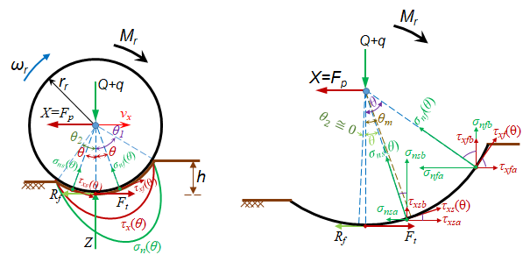
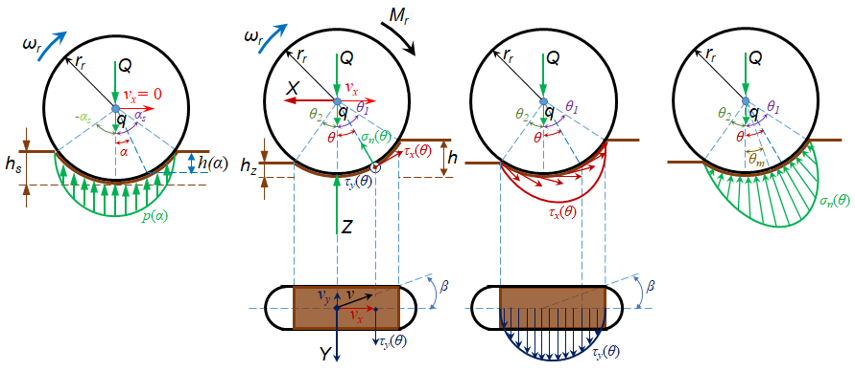
Starting from the Bekker and Wong models, a mathematical model is developed to analyze the interaction between the running path and the propulsion system. The novelty element that appears in the development of the models is the fact that the nodal theory is used. Applying the nodal theory specific rules, namely associating wheels with global nodes loaded with forces and torques that are characterized by kinematic factors, applying of the energy conservation laws and balance of load factors entering and leaving the node, a series of equations is written, which in the end, leads to the determination of expressions that approximate the ability to predict the required torque and power when moving the UGV with wheels or tracks on deformable terrain, as well as information about the kinematics of the UGV. The analysis of the interaction between the ground and the propulsion system is carried out taking into account slipping, wheels sinking, as well as soil deformation by shear stresses in between the ground and the propulsion system. In other words, the mathematical model that analyzes the interaction between the running path and the wheeled or tracked propulsion system introduces an algorithm for determining the energy consumption when moving the UGV on deformable terrain while traveling in a straight line and during turning.
The mathematical model implemented for the analysis of the interaction between the terrain and the tracked propulsion system, led to the determination of the energy consumption balance parameters of the tracked UGV, when traveling on deformable terrain, namely the traction force, the slip of the track in relation to the running path as well as the drag force due to soil compaction. The approximation of the traction force is obtained starting from the second fundamental equation of terramechanics, based on the specific relations of soil shear stresses along the movement direction of the tracked robot. The drag force is approximated by integrating the horizontal components of the pressure force, normal to the track in contact with the ground, for both tracks. By referring to the difference between the traction force and the drag force a relationship is obtained approximating the hook force.
The turning dynamics resulted from the equilibrium conditions of the forces acting on the UGV. The drag forces generated by soil compaction were approximated with the fundamental equations of terramechanics. The resistant torque during turning was determined starting from the transverse resistance forces that appear while turning, and the traction forces from the inner and outer tracks by integrating the shear stress defined by the fundamental equations of terramechanics.
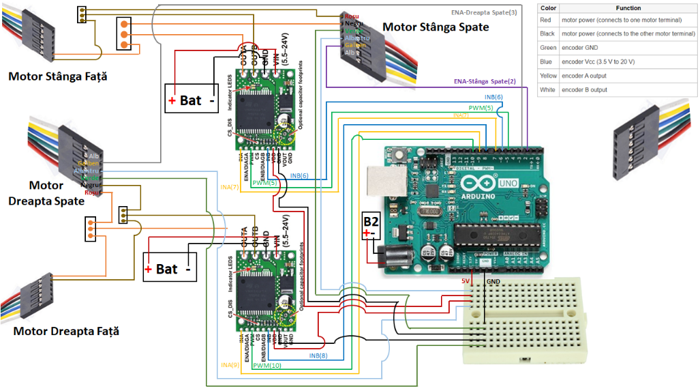
In order to analyze the evolution of wheeled or tracked propulsion during turning maneuvers on deformable terrain, wheeled and tracked platforms were built and programmed to turn by slipping. The paper presents the electrical diagram that allows their operation, as well as the components used in their construction. The developed programs are capable of commanding the UGV to move forward and turn, over an imposed distance, while maintaining the direction of travel, by continuously correcting the trajectory.
The modeling of the direct current motor consisted in determining equations capable of approximating its functional parameters: torque, speed and power. Using the motor’s operation diagram, Kirchhoff’s second law and Newton’s second law of dynamics were applied to determine the relations that approximate the motor’s functional parameters. Mathematical models proposed for modeling the wheeled or tracked UGV in motion highlight the fact that the power sent to the electrical circuit by the DC motors is not fully used for UGV traction. Part of it is transformed into inertia, as a result of the physical process of acceleration of elements in rotary motion, or transformed into dissipative power, as a result of the existing frictions between parts in rotary motion. Through mathematical modeling, the dependence between the traction force of the UGV and the drag forces that appears when the UGV moves, including the acceleration drag force, is highlighted, and an equation is proposed that highlights the energy balance between the active, resistance and inertia forces that appear when the UGV moves in non-uniform motion.

The UGV dynamics simulation model is developed in the Matlab, Simscape programming environment. Using pre-defined blocks from the software libraries, a diagram is developed capable of modeling the DC motors, motor control and supply, the planetary gearbox from the motor structure, the interaction between the propulsion system and the running path, as well as the connection between the propulsion system, motor and UGV body.

Completing the diagram is followed by entering the input data into the model.
Following the simulation process, the simulation model is able to deliver relevant graphs for the forces and torques that load the UGV structure components, as well as for the UGV kinematics.