STAGE 1

Algorithms to improve the efficiency of the UGV propeller’s kinematics when moving on rough terrain

Project Activity Report

The first stage of the project, Systematic analysis of propulsion solutions for wheeled and tracked UGVs with the highlighting of kinematic and energetic characteristics, involves bibliographic research activities and aimed at studying elements of kinematics and dynamics of wheeled and tracked robots during their movement in a turn or when walking in a straight line.
The objective of the bibliographic research activity was to analyze the main constructive types of wheeled and tracked robots, but also to identify and interpret the existing approaches regarding robot kinematics and dynamics. Results of the bibliographic research activity were materialized by highlighting the construction and structure elements of wheeled and tracked robots, but also by clarifying some aspects related to kinematics and dynamics, as a result of the analysis of models that study the kinematics and dynamics of wheeled and tracked robots, with an emphasis on algorithms for determining expressions for calculating turning radius, travel speed, robot trajectory equations, forces and moments acting on the driven and free wheels of robots, and algorithms that highlight the influence of ground characteristics on the dynamic performance of robots.

Starting from the results obtained from the bibliographic research activity, the study activities on kinematics and dynamics, specific to the project implementation plan, had as their objective the presentation of some models for estimating the kinematics and dynamics of wheeled and tracked robots that highlight the kinematics of the thruster in straight-line and cornering, the ability to generate the robot’s trajectory equations, and the forces and moments acting on the driven and idler wheels in straight-line and cornering.

Within the kinematic models, the assumptions, calculation schemes and constitutive kinematic equations are presented, while the dynamic models show how to determine the forces and moments acting on the wheels and the robot, but also how to determine the influences that the longitudinal and transversal slides have on the travel path.

The model for estimating the kinematics and dynamics of tracked robots takes into account the physico-mechanical characteristics of the ground, the influence of the center of gravity displacement on the cornering moment of resistance, and the interaction of the track with the roadway. During the development of the model, simplifying calculation assumptions are imposed by which the track is considered to be rigid, the turn is made uniformly and at a constant speed, and the terrain is considered horizontal. For the determination of the resistance forces and the traction force, specific calculation relations of the Wong model and those of the Bekker model of experimental determination of soil characteristics are used. The model requires prior knowledge of the physicalmechanical characteristics of the soil. The results of the model are characterized by defining computational relations for the robot’s equations of motion, longitudinal forces, transverse forces, and resistive turning moments generated by longitudinal forces and transverse forces.
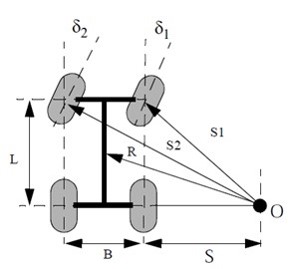
Models for estimating the kinematics and dynamics of wheeled robots are specific to fourwheeled robots in which turning is achieved by turning steering wheels or by skidding as in tracked robots. The model of the robot turning by skidding is designed under the assumption that the wheels keep their plane of symmetry unchanged, the turning radius depends on the speeds of the wheels on the two sides of the robot, and the turning process is accompanied by the side skidding of the wheels. The wheel force and moment expressions determined by the dynamic model are used as input data by the kinematic model to estimate the longitudinal and lateral slips, and based on them, the robot trajectory characteristics are determined. The model of the robot that executes the turn by steering is developed under the assumption that the wheels roll purely, i.e. without longitudinal or lateral slips. The longitudinal forces depend on the moments applied by the electric motors, while the transverse forces depend on the cornering conditions, so on the steering angles of the